

Last updated: November 13, 2026. Builder prices come from each app’s Shopify App Store listing, checked on November 4, 2026. App store fees come from Apple and Google. Disclosure: Webiots builds Shopify apps and custom mobile apps. No apps in this guide paid to be included.
Quick answer: A Shopify mobile app built with an app builder costs from $99 to $1,000 a month for the entry plan, or nothing upfront with a builder that takes 3% of in-app sales. Add Apple’s $99 a year developer fee and Google Play’s $25 one-time fee. That puts the first year at about $1,300 to $2,500 for most small and mid-size stores, around $6,100 for Tapcart and over $12,000 for AppMaker. Features such as segmented push or abandoned cart alerts often need a higher plan, so price the plan you actually need.
Key takeaways:
- Entry plans run from $99 to $1,000 a month.
- Add $99 a year for Apple and $25 once for Google.
- Check for revenue-share fees on top.
- Price the plan with the features you need.
In this guide
- What a Shopify mobile app costs
- First-year cost by builder
- App store fees
- Hidden costs to budget for
- Free plan with a sales fee vs a fixed plan
- Custom app vs app builder
- Is a mobile app worth the cost?
- FAQ
How Much Does a Shopify Mobile App Cost?
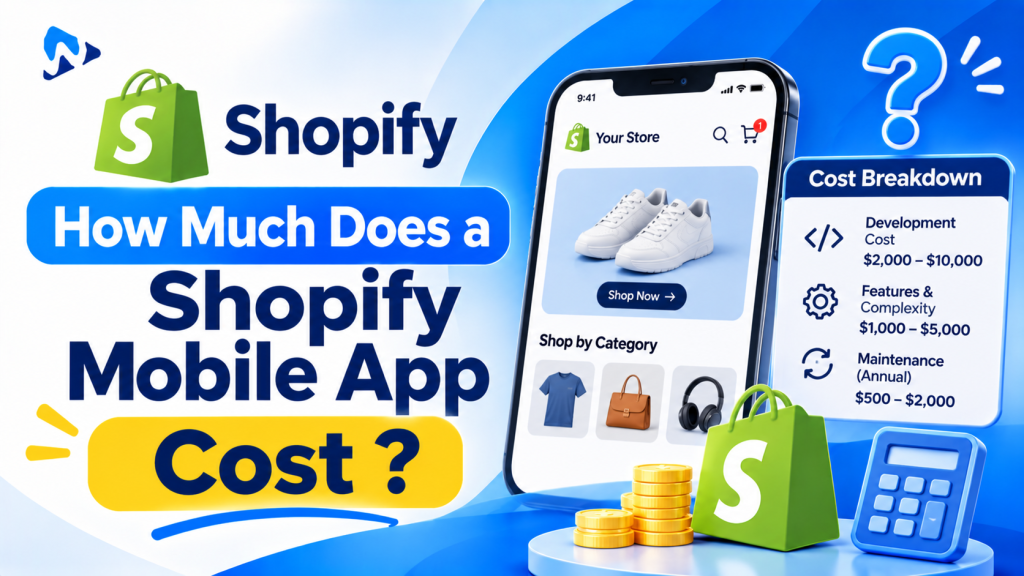
Most Shopify stores pay between $99 and $600 a month for an app builder, plus app store fees. The total depends on three things: the builder’s plan, any share of in-app sales the builder takes, and the features you need.
| Option | Typical cost | Best for |
|---|---|---|
| Free plan with a sales fee | $0 a month + 3% of in-app sales | Testing an app with low risk |
| Entry builder plan | $99 to $199 a month | Small and growing stores |
| Mid builder plan | $249 to $599 a month | Segmented push, abandoned cart alerts, multi-language |
| Enterprise builder plan | $1,000 to $2,850+ a month | Large brands needing A/B tests and dedicated support |
| Custom-built app | Upfront development quote + ongoing maintenance | Unique features no builder offers |
What Does Each Builder Cost in the First Year?
First-year cost is 12 months of the entry plan plus Apple’s $99 and Google’s $25. Entry prices are from each Shopify App Store listing, checked on November 4, 2026.
| Builder | Entry plan | First-year total | Also note |
|---|---|---|---|
| Plobal | Free + 3% of in-app sales | $124 + 3% of app sales | Segmented push from $499 |
| MageNative | $99/mo | $1,312 | Only 5 push notifications on Starter; unlimited from $249 |
| Shopney | $149/mo | $1,912 | Abandoned cart alerts from $299 |
| Superfans (formerly Vajro) | $150/mo | $1,924 | Next plan is $1,000 |
| Appbrew | From $199/mo | From $2,512 | Extra charges based on app performance |
| Tapcart | $500/mo | $6,124 | A/B testing from $1,250 |
| AppMaker | $1,000/mo + 1% of in-app revenue | $12,124 + 1% of app revenue | Highest entry price |
For features, ratings and trials for each builder, see our Shopify mobile app builders comparison.
What Do Apple and Google Charge to Publish an App?
Apple charges $99 a year for its Developer Program, and Google Play charges a one-time $25 registration fee. Most builders publish your app under your own developer accounts, so the app listing belongs to your brand.
- Apple Developer Program: $99 a year, renewed every year (Apple)
- Google Play Console: $25 once (Google)
Physical products sold through a shopping app are paid through Shopify checkout, so Apple and Google don’t take a commission on those sales.
What Hidden Costs Should You Budget For?
- Plan upgrades for key features. Abandoned cart alerts, segmented push and multi-language support are often on mid-tier plans.
- Revenue-share fees. Some plans take 1% to 3% of in-app sales on top of the monthly price.
- Performance-based charges. Some builders list extra charges tied to app usage.
- Integrations. Reviews, loyalty, subscriptions and email apps may need a higher plan or their own app-support fee.
- Design time. Banners, icons and app store screenshots take time, or a designer’s fee.
- Promotion. An app-only discount for first orders is the most common launch offer, so count it as a cost.
Is a Free Plan With a Sales Fee Cheaper Than a Fixed Plan?
A 3% sales fee is cheaper until your app sales grow past a break-even point. Compare it with a fixed $99 a month plan:
- Break-even: $99 / 3% = $3,300 of in-app sales a month
- Below $3,300 a month, the 3% plan costs less.
- Above $3,300 a month, the fixed plan costs less. At $10,000 of app sales, 3% is $300 a month.
Start with the low-risk plan, then switch to a fixed plan once app sales pass your break-even point.
Should You Build a Custom App Instead?
A custom app costs much more upfront and needs ongoing maintenance, so it only makes sense when no builder can do what you need.
| App builder | Custom app | |
|---|---|---|
| Upfront cost | None or a free trial | A development project |
| Ongoing cost | Monthly plan | Maintenance, OS updates and hosting |
| Time to launch | Usually weeks | Usually months |
| Features | The builder’s blocks and integrations | Anything you specify |
Is a Shopify Mobile App Worth the Cost?
An app pays off when the extra repeat orders it brings cover the monthly cost. Illustrative example with assumed numbers, not a real store’s results: a store pays $149 a month. Its average order is $60 with a 50% gross margin, so each order earns $30 before other costs. The app needs about 5 extra orders a month ($149 / $30) to cover itself.
Apps work best for stores with repeat customers, such as fashion, beauty, food and supplements, and a list of past buyers to invite. If most of your customers buy once, improve your mobile website first.
Frequently Asked Questions
How much does a Shopify mobile app cost per month?
Entry plans range from $99 a month (MageNative) to $1,000 a month plus 1% of in-app revenue (AppMaker). Plobal has a free plan that takes 3% of in-app sales.
Is there a free way to make a Shopify mobile app?
Plobal’s free plan has no monthly fee but takes 3% of in-app sales, and you still pay Apple’s $99 a year and Google’s $25 once.
Do Apple and Google take a cut of Shopify app sales?
Physical products in a shopping app go through Shopify checkout, so Apple and Google don’t take a commission. You pay their developer fees.
What is the cheapest Shopify mobile app builder?
Plobal has the lowest upfront cost with its free plan. MageNative has the lowest fixed monthly price at $99, though its Starter plan includes only 5 push notifications.
How much does a custom Shopify mobile app cost?
It’s quoted as a development project and costs much more upfront than a builder, plus ongoing maintenance. Get quotes based on the exact features you need.
Related Reading
- Best Shopify Mobile App Builders in 2026: 7 Compared
- Shopify BFCM 2026: The Complete Guide
- 10 Best Shopify Loyalty Apps (2026)
Update Log
November 13, 2026: First published with entry prices for 7 builders, first-year totals, app store fees, hidden costs and a sales-fee break-even example.