

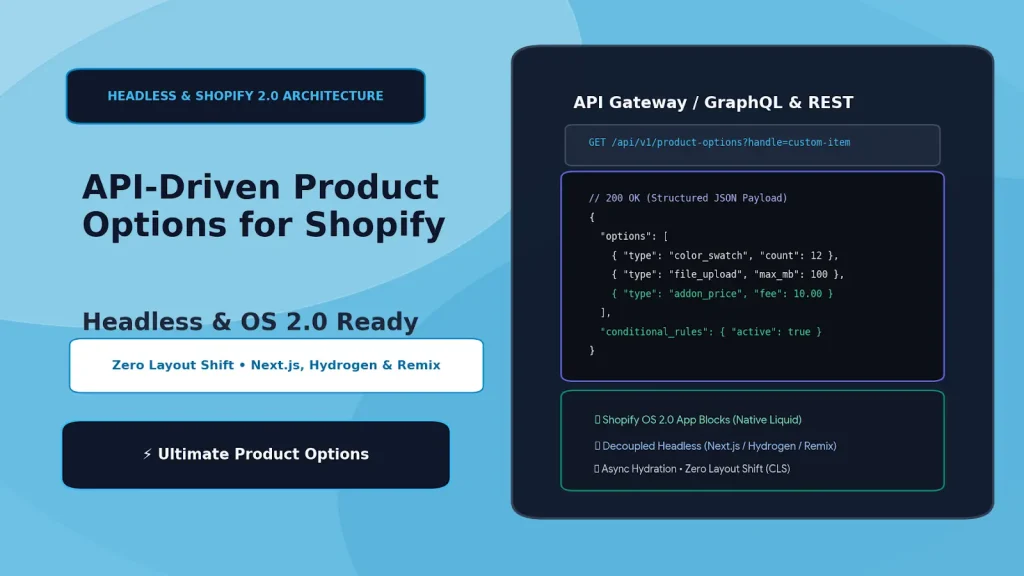
Headless & 2.0 Ready: Why Modern Shopify Stores Need API-Driven Product Options
As e-commerce engineering teams scale their Shopify infrastructure, frontend performance and architectural flexibility become top priorities. Brands increasingly transition to Shopify Online Store 2.0 (OS 2.0) theme app blocks or decouple their storefronts into headless architectures (using Next.js, Remix, Hydrogen, or Gatsby) to achieve sub-second page loads and bespoke user interfaces.
However, complex product customization frequently becomes the bottleneck in modern frontend architectures.
Legacy product option apps rely on brittle DOM injection scripts, heavy asset payloads, and synchronous render cycles that degrade Core Web Vitals (CWV) and break entirely in headless environments.
To build fast, scalable, and customizable shopping experiences, engineering teams need API-driven product option architectures that operate seamlessly across both Shopify 2.0 app blocks and decoupled headless frontends.
The Architectural Flaws of Legacy Product Option Plugins
Traditional product option tools were built for monolithic themes. When integrated into modern architectures, they introduce several technical failure points:
1. Client-Side DOM Injection & Cumulative Layout Shift (CLS)
Legacy tools load a global JavaScript bundle that traverses the DOM, targets hardcoded theme selectors (e.g., .product-form), and dynamically injects HTML inputs after the page renders. This execution path causes noticeable Cumulative Layout Shift (CLS), delaying Largest Contentful Paint (LCP) and harming SEO performance.
2. High Bundle Bloat & Render Blocking
Many legacy apps bundle monolithic jQuery libraries, redundant CSS frameworks, and uncompressed assets that block the browser's main thread during initial hydration.
3. Total Failure in Headless Storefronts
In a headless setup, there is no Liquid theme or default Shopify DOM for legacy scripts to hook into. Without structured endpoints or a GraphQL/REST API to query option schemas, conditional rules, and dynamic price modifiers, developers are forced to hardcode customizations or abandon third-party apps altogether.
The Modern Solution: App Blocks & API-Driven Architecture
Modern Shopify customization demands an API-first approach that decouples option logic and data storage from frontend rendering.
┌────────────────────────────────────────────────────────┐
│               Shopify Admin / Database                 │
│         Option Sets, Dynamic Pricing, Rules            │
└───────────────────────────┬────────────────────────────┘
                            │
              ┌─────────────┴─────────────┐
              ▼                           ▼
  [ Shopify 2.0 App Block ]      [ REST / GraphQL API Gateway ]
  Native Async Theme Render      Structured JSON Payloads
  Zero Layout Shift              (Next.js / Hydrogen / Remix)
1. Shopify Online Store 2.0: Clean Native Integration
For liquid-based storefronts, Shopify 2.0 App Blocks provide a standardized, high-performance integration model:
- Zero Theme Code Contamination: App blocks inject modular Liquid directly into the theme JSON template without modifying core theme files or leaving orphaned scripts upon uninstallation.
- Asynchronous Loading: Option logic loads asynchronously alongside theme components, preventing main-thread blocking during critical render paths.
- Merchant Customization in Theme Editor: Non-technical store operators can reposition the option block, adjust typography, and configure layout spacing directly in the native Shopify theme visual customizer.
2. Headless Commerce: API Gateways for Custom Frontends
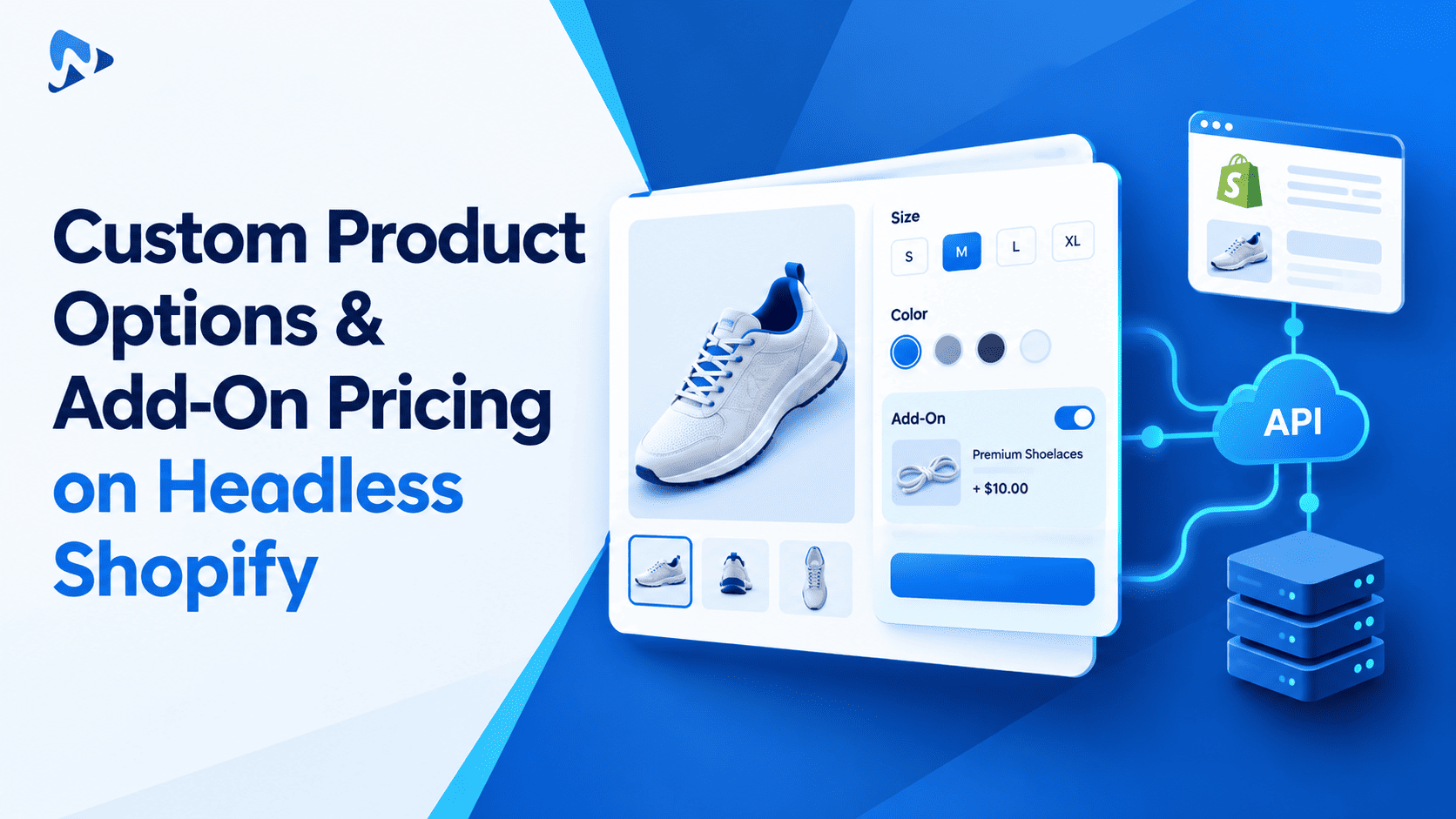
In headless environments (Next.js, Hydrogen, Remix), product options must be fetched as structured data rather than injected HTML.
Using an API-driven solution like Ultimate Product Options provides developers with access to a robust API gateway to programmatically query and manage customization schemas:
Typical Headless Execution Workflow:
- Schema Retrieval: Query the API endpoint using the product ID or handle to fetch associated option sets, input types (swatches, text inputs, file dropzones), validation rules, and price modifiers in structured JSON.
- Native Component Rendering: Render UI elements using your custom design system (e.g., Tailwind CSS, Radix UI, or custom React components) without third-party styling conflicts.
- Client-Side Validation & Logic: Evaluate conditional display rules locally based on the structured condition payload.
- Cart Mutation: Dispatch the selected custom options as standard Shopify
customAttributesorpropertiespayload into the Shopify Storefront API cart mutation.
Performance Comparison: Legacy Scripts vs. API-Driven Options
| Metric / Requirement | Legacy DOM-Injected Apps | Modern API & 2.0 App Block Model |
|---|---|---|
| Theme Integration | Hardcoded script tags in theme.liquid |
Clean App Blocks within JSON templates |
| Core Web Vitals Impact | High CLS, delayed LCP, main-thread blocking | Minimal footprint, asynchronous hydration |
| Headless Compatibility | Incompatible (Relies on Liquid DOM) | Fully compatible via REST/GraphQL APIs |
| Dynamic Price Handling | Fragile client-side cart intercept scripts | Native calculated price add-ons via cart properties |
| Multi-Channel Scalability | Online store only | Mobile apps, POS, headless, and Online Store 2.0 |
Why Developers Choose Ultimate Product Options for Modern Stacks
Ultimate Product Options is engineered specifically for modern e-commerce architectures, bridging the gap between no-code merchant usability and developer flexibility.
- Native 2.0 App Block Architecture: Clean integration with modern Shopify themes without theme bloat or code pollution.
- Developer API Gateway: Programmatically create, sync, and retrieve option schemas for custom headless storefronts and mobile apps.
- 42+ Stylized Option Types: Full API support for image swatches, text fields, file uploads up to 100MB, date pickers, and multi-select components.
- Conditional Logic Engine: Structured rule schemas that evaluate dynamically without UI lag.
- AI-Assisted Schema Generation: Generate full option sets rapidly using natural language prompts or UI screenshots, cutting development staging time.
Conclusion
Modern Shopify development requires architectures that prioritize speed, maintainability, and omnichannel flexibility. Relying on legacy DOM-injecting plugins creates technical debt, degrades user experience, and blocks headless migrations.
By implementing an API-driven, OS 2.0-native solution like Ultimate Product Options, engineering teams and scaling brands can deliver rich, high-converting product customization while maintaining sub-second page performance and clean codebases across all sales channels.