Published: November 25, 2026. Supplier details come from each supplier’s own pages, and app plans from the Shopify App Store, checked November 2026. Disclosure: Webiots develops Ultimate Product Options, the personalization app used in the setup steps.
Quick answer: To sell custom phone cases on Shopify, connect a print-on-demand supplier such as Printify, Printful, Gelato or Printeers, pick a few case types and popular phone models, and list one product per design with the phone model as a variant. If shoppers add their own name or photo, collect it with a product options app so it doesn’t create extra variants. Order samples, price for at least a 50% margin, and market on TikTok and Instagram.
Key takeaways:
- Print on demand means no inventory and low startup cost.
- Start with the newest iPhone and Samsung models only.
- Phone model and case type are variants; names, photos and fonts are options.
- Always order a sample before selling a design.
In this guide
Is Selling Custom Phone Cases Worth It?
Yes, for most new stores. Phone cases are small, light and cheap to ship, people buy a new one each time they change phones, and many buyers choose a case for its look. Shopify reports that 55% of Americans replace their phone every two to three years and 12% every year. Printeers, citing Grand View Research, puts the global phone case market at over $25 billion in 2024, and reports that 38% of younger buyers prefer custom-designed cases.
The catch is competition. Generic cases are everywhere, so the stores that win pick a clear niche (pets, gaming, minimalist, names and initials) and make personalization easy.
3 Ways to Make Phone Cases
| Model | How it works | Upfront cost | Best for |
|---|
| Print on demand | The supplier prints and ships each case after it’s ordered | Very low | Beginners, testing designs, wide model range |
| Bulk from a manufacturer | Buy printed or blank cases in bulk and ship them yourself | Medium to high (minimum order quantities) | Proven designs, better margins, custom packaging |
| Handmade | Decorate clear cases yourself with paint, pressed flowers, charms or resin | Low | One-of-a-kind and premium cases |
Most stores start with print on demand, then move best-selling designs to bulk production once they know what sells.
Print-on-Demand Phone Case Suppliers Compared
All four connect to Shopify through an app, sync products to your store and send orders to production automatically. Shopify says most POD orders are printed in 2 to 7 business days, plus shipping.
| Supplier | What stands out | Good to know |
|---|
| Printify | Network of print providers, so you can compare costs and locations for the same case | Phone cases are under Accessories in its catalog |
| Printful | Prints in its own facilities, giving more control over quality and branding | Fewer provider choices than Printify |
| Gelato | 140+ production facilities worldwide, printing close to the customer | Useful when you sell in many countries |
| Printeers | Specializes in phone and device cases: soft, tough, hybrid, wallet, crossbody and biodegradable | Ships from Europe and the US; adds new phone models to the catalog automatically |
Pick by the phone models each supplier supports, the case quality in your sample, and delivery time to your main market, not just the base price.
Case Types and Materials
| Case type | What it is | Who buys it |
|---|
| Slim / soft (TPU or gel) | Thin, flexible, low cost | Design-first buyers, gifts |
| Tough / hybrid | Hard polycarbonate shell with a TPU inner layer | Buyers who want protection |
| Clear | Transparent case with a printed name or design | Name and initial cases |
| Wallet / folio | Cover with card slots | Commuters, older buyers |
| Silicone | Soft grip, solid colors | Color-led collections |
| MagSafe / crossbody | Magnetic charging support, or a strap to wear the phone | Higher price point, upsells |
Start with two types, usually a soft case and a tough case, so you can offer a cheaper and a premium price.
Which Phone Models Should You Start With?
Don’t try to cover every phone. Start with the newest iPhones and Samsung Galaxy phones, which are what most buyers use. According to YouGov data cited by Shopify, the most popular models in Q2 2026 were the iPhone 16 Pro, Samsung Galaxy S25 and iPhone 17. Add older or less common models only when customers ask for them, and add new models the week they’re released, when people are buying new cases.
How to Set Up Phone Case Variants on Shopify
This is where most phone case stores go wrong. Use
one Shopify product per design, and make the phone model the first variant option, because that’s the first thing shoppers check.
| Choice | Set it up as | Why |
|---|
| Phone model | Variant (option 1) | Each model is a different physical case and SKU |
| Case type | Variant (option 2) | Different cost and price |
| Finish (gloss, matte) | Variant (option 3), if your supplier offers it | Changes the product made |
| Name, initials, photo, font, text color | Product options | Free text and uploads can’t be variants |
Check the math: 20 phone models × 2 case types × 2 finishes is 80 variants per design, well inside Shopify’s 2,048-variant limit. Stay under 100 variants per product where you can, because some themes and apps still struggle above that. See our guide to the
Shopify variant limit for details.
How to Let Customers Personalize Their Case
Personalized cases, with a name, initials, a pet photo or a family photo, sell at higher prices than stock designs. Shopify’s built-in product page has no field for this, so you need a product options app to collect it. The choices are saved on the order (as line item properties), so you or your supplier know exactly what to print.
Common personalization options for phone cases:
- Name or initials: a text box with a character limit.
- Font and text color: image swatches so shoppers see each style.
- Photo upload: for pet, couple and family photo cases.
- Placement: top, center or bottom of the case.
- Add-ons: gift wrap, a screen protector or a crossbody strap, each with an extra price.
Check this before you sell personalized cases with print on demand: POD apps print the fixed design you uploaded. Personalized text and photos arrive on the order, so confirm how your supplier handles per-order artwork, or create the final file and submit it yourself for each order.
Set it up with Ultimate Product Options
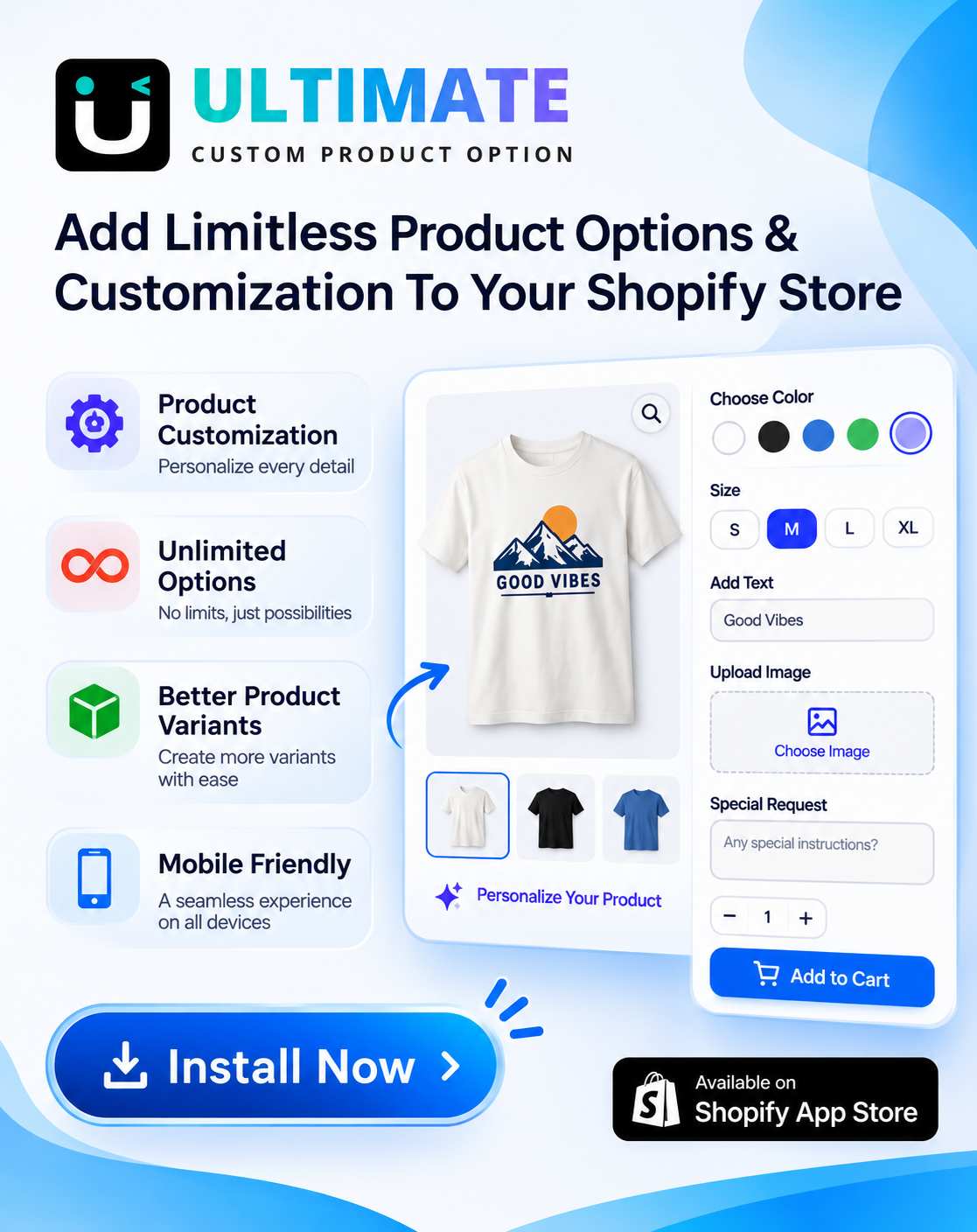
Ultimate Product Options is our app, rated 5.0 on the Shopify App Store. Here’s how to add personalization to a phone case:
- Install Ultimate Product Options and create an option set called “Personalize your case”.
- Add a text box for the name, with a character limit that fits the case (Free plan).
- Add font and text-color swatches (Free plan), and an add-on price for personalization if you charge for it (Free plan).
- Add a photo upload field and conditional logic, so the upload only shows when a shopper picks “Photo case” (Basic plan, $7.99/month).
- Turn on live text preview so shoppers see their name on the case image before buying (Advanced plan, $12.99/month).
- Assign the option set to all your phone case products and place a test order to check the name, font and photo show on the order.
Other apps for personalized phone cases
- Customily: a print-focused personalization app with photo, text and clipart cases in its demo store.
- Easify Product Options: rated 4.9 from 3,276 reviews, with a free plan.
- Globo Product Options: rated 4.9 from 5,319 reviews, with a free plan.
- Podifai: a product customizer with text input, image upload and live preview.
For a full comparison, see
the best Shopify personalization apps.
Artwork Rules for Phone Cases
- Use high-resolution files, usually 300 DPI PNG.
- Design on your supplier’s template for each model, and keep text out of the camera cutout, button areas and curved edges.
- Avoid very thin lines and tiny text, which can look different once printed.
- Use your own artwork or properly licensed graphics. Don’t use brand logos, celebrities or copyrighted characters.
- If you use AI images, check that you’re allowed to use them commercially.
- Order a sample to check fit, colors and print sharpness, and use it for your product photos and videos.
Pricing and Profit
Custom phone cases usually sell for $20 to $49. Printeers gives a real example: a soft case shipped to Germany costs €7.88 in total (€5.53 for the case and €2.35 for shipping). Shopify’s own POD profit calculator uses a $9 case cost and a $27 price.
| Example (illustrative) | Stock design | Personalized name case |
|---|
| Selling price | $24.99 | $29.99 |
| Case and printing | $9.00 | $9.00 |
| Shipping | $4.00 | $4.00 |
| Payment fees (approx.) | $1.00 | $1.20 |
| Profit before ads | $10.99 | $15.79 |
These figures are examples, not supplier quotes. They leave out your Shopify plan, apps, ads, taxes and returns, so check your supplier’s real prices for each model. The table shows why personalization matters: the case costs the same, but the $5 higher price adds about $4.80 of profit per order.
What to Put on the Product Page
- Compatible phone models, repeated near the Add to cart button.
- Case type and material (TPU, polycarbonate, silicone), and whether it supports MagSafe or wireless charging.
- Mockups on the real case, plus photos or a short video of your sample.
- Production and delivery time, for example “printed in 2–7 business days, then shipped”.
- How personalization works, what the preview shows, and that personalized cases can’t be returned unless faulty (if that’s your policy).
- Care notes and your return policy.
Phone Case Brands to Learn From
- CASETiFY: lets shoppers add their own photo and text, and separates choosing the case from designing it.
- Skinnydip London: a “Create Your Case” tool for names, slogans, emojis and stickers.
- Keyway: monogram cases with inlaid letters, with preview limits explained next to the controls.
- The Dairy: new designs every week and name personalization.
- BURGA: groups phone model and case type around one pattern, and grew into iPad, AirPods and watch accessories.
- Velvet Caviar: seasonal collections with large images and simple model selection.
How to Market Custom Phone Cases
- TikTok and Instagram Reels: short videos of unboxing, case swaps and the personalization process.
- Pinterest: aesthetic designs do well and keep sending traffic for months.
- Model-specific SEO: include the exact model in titles and collections, like “iPhone 17 Pro custom name case”.
- New phone launches: list cases for new models as soon as your supplier supports them.
- Creators: send free personalized cases to small creators in your niche.
- Paid ads: test Meta and TikTok ads once a few designs are selling on their own.
- Gifting: push name and photo cases before Valentine’s Day, Mother’s Day and the holidays.
Your 7-Day Launch Plan
| Day | What to do |
|---|
| 1 | Pick your niche, brand name and 2 case types |
| 2 | Create 10–15 designs and one personalized design |
| 3 | Set up Shopify: theme, policies, payments, shipping |
| 4 | Connect your POD supplier and order samples |
| 5 | Publish products with model variants and add personalization options |
| 6 | Place a test order and check the order details |
| 7 | Launch and post your first videos |
Common Mistakes
- Listing every phone model from day one, then managing hundreds of variants nobody buys.
- Making names or fonts into variants instead of product options.
- Skipping samples and finding out about print or fit problems from customers.
- Text too close to the camera cutout or edges.
- Not saying how long production takes, which leads to “where is my order” emails.
- Using copyrighted characters or logos.
The Bottom Line
The easiest way to sell custom phone cases on Shopify is print on demand: pick a niche, start with two case types and the newest iPhone and Samsung models, and list one product per design with the phone model as a variant. Add name and photo personalization with a product options app to raise your price, order samples, and let short videos do the marketing.
Want to add name and photo options to your cases?
Install Ultimate Product Options free or
learn more about the app.
Frequently Asked Questions
Can I sell phone cases on Shopify without inventory?
Yes. Connect a print-on-demand supplier like Printify, Printful, Gelato or Printeers. Each case is printed and shipped after it’s ordered.
How much does it cost to start a phone case business?
With print on demand, mainly your Shopify plan, samples and marketing. Buying in bulk costs more upfront because of minimum order quantities.
Are custom phone cases profitable?
They can be. Cases cost little to make and ship, and personalized cases sell for more. Most stores aim for at least a 50% margin before ads.
How long does print-on-demand take?
Shopify says most POD orders are printed in 2 to 7 business days, plus shipping time.
Should each phone model be a separate product?
No. Use one product per design and make the phone model a variant, so shoppers pick their model on the same page.
How do I let customers add their name or photo?
Use a product options app to add a text box or photo upload. The details are saved on the order so the case can be printed correctly.
What’s the best material for phone cases?
TPU for flexible soft cases, polycarbonate for hard and tough cases, and silicone for a soft-grip feel.
Are phone cases good for dropshipping?
Yes. They’re light and cheap to ship, but generic cases face heavy competition, so a niche or personalization helps.
Related Reading
Update Log
November 25, 2026: First published. Supplier details and app plans checked against the sources below.
Sources