





- API INTEGRATION SERVICES
API Integration Services That Keep Your Systems Connected
Connect the applications your business depends on. Webiots builds API integrations that move agreed data between systems, trigger the right actions, and reduce repeated manual updates across your operations.
- Third-Party API Integration
- CRM & ERP Connections
- Data Synchronization
- Webhook Integration
- Custom Middleware

FROM APPLICATIONS TO WORKFLOWS
Make Your Business Work Together Through Clear Connections
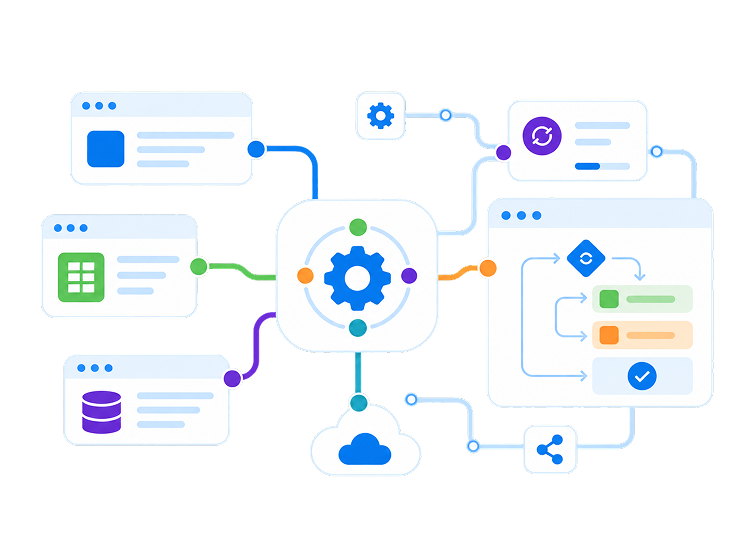
When systems hold different versions of the same information, teams spend time copying records and resolving mismatches. API integrations provide defined ways for applications to exchange information and request supported actions.
At Webiots, we design those connections around your business rules and the capabilities of each system. We define what moves, when it moves, who owns the data, and how exceptions are handled.
- Assess - Review the applications, available APIs, access requirements, usage limits, and workflows you want to connect.
- Map - Define fields, record identifiers, authoritative data sources, and the direction of each update.
- Design - Plan authentication, synchronization timing, validation, error handling, and monitoring requirements.
- Build - Develop the connectors, transformations, and middleware needed to support the agreed integration.
- Validate - Test normal updates, missing data, duplicate events, expired access, and unavailable services.
- Maintain - Monitor integration health and update connections as provider APIs and business requirements change.
OUR API INTEGRATION CAPABILITIES

Connect Data, Actions, and Events Across Your Applications
We build integrations that make system interactions understandable, testable, and manageable throughout their lifecycle.
01.
Third-Party API Integration
Connect approved external services to your website, application, or internal platform through their supported APIs.
02.
CRM, ERP & Accounting Connections
Exchange agreed customer, order, product, and business records between operational systems.
03.
Payment & Commerce Integration
Connect supported payment, subscription, order, and fulfillment services with the application workflows that depend on them.
04.
Data Mapping & Synchronization
Transform records into the required formats and apply defined rules for identifiers, validation, and update conflicts.
05.
Webhook & Event Integration
Process verified system events and trigger relevant actions, with handling for duplicate or delayed notifications.
06.
Custom Connectors & Middleware
Develop services that coordinate multiple APIs, translate data, and provide a maintainable connection between applications.
07.
Authentication & Access Setup
Configure supported authorization methods, credentials, and scopes around the specific actions the integration requires.
08.
Monitoring & API Lifecycle Support
Track failures and processing delays, document dependencies, and adapt integrations to relevant provider changes.
BUSINESS IMPACT
Reduce Manual Coordination Between the Tools You Already Use
Our API integrations are designed to improve information flow and help your team manage connected processes with greater visibility.
Automate repetitive tasks and time-consuming workflows
Extract, classify, summarize, and organize information from documents, invoices, contracts, forms, and business records with AI.
Enterprise Knowledge Assistant
Help employees instantly find answers across internal documents, policies, databases, and company knowledge.
Smart Ecommerce Experience
Improve product discovery with personalized recommendations, intelligent search, AI assistants, and automated merchandising.
AI Document Processing
Extract, classify, summarize, and process information from invoices, reports, forms, contracts, and other documents.
Predictive Business Dashboard
Combine business data with AI models to identify patterns, forecast trends, and support strategic decisions.
AI Content Workspace
Generate, organize, improve, summarize, and manage content through intelligent tools integrated into existing workflows.
OUR API INTEGRATION PROCESS
From Connection Requirements to a Maintainable Integration
We follow a practical process that turns integration requirements into reliable connections with clear data flows, error handling, and ongoing monitoring.
01.
Integration Discovery
Identify the business workflow, connected systems, API owners, access requirements, and success criteria.
02.
API & Data Assessment
Review documentation, supported operations, environments, rate limits, field structures, and expected data volumes.
03.
Integration Design
Define mappings, synchronization direction, event handling, credentials, validation, and recovery behavior.
04.
Connector Development
Build application connections, middleware, transformations, and relevant monitoring or administrative tools.
05.
Scenario & Failure Testing
Test valid updates, partial failures, repeated events, authorization errors, rate limits, and safe recovery paths.
06.
Deployment & Ongoing Monitoring
Launch with approved access, document the integration, and monitor its behavior as systems and workloads evolve.
WHY WEBIOTS
An Integration Partner Focused on How the Connection Operates
Business Rules Before Data Transfer
01.
We clarify why information is moving and what each connected system should do with it.
Clear Data Ownership
02.
We define authoritative sources, identifiers, and conflict rules to support consistent updates.
Attention to Failure Scenarios
03.
We plan for unavailable services, invalid records, access problems, and repeated events during development.
Appropriate Access Controls
04.
We configure required permissions and credential handling around the systems being connected.
Maintainable Integration Design
05.
We organize connectors and transformations so changes can be understood, tested, and deployed.
Visibility After Launch
06.
We include relevant monitoring and documentation to help your team understand the integration’s health and dependencies.
 AI APPLICATIONS ACROSS INDUSTRIES

Intelligent Solutions for Every Industry
We architect next-generation digital ecosystems by integrating deep technical expertise with advanced AI to redefine performance and scale across the world’s most critical sectors.
Logistics
Operations agents, shipment tracking, document processing, planning, and workflow automation.
Inventory · Payments · Tracking
FinTech
High-frequency algorithmic trading and autonomous risk assessment modeling.
Payments · Wallet · Security
Real Estate
Neural-network-based property valuation and intelligent spatial analytics.
Listing · Leads · Search
AI Industry 4.0
Cognitive digital twins and real-time edge-computing for industrial automation.
Automation · Dashboard · Workflow
Automoblie
Autonomous driving perception systems and predictive vehicle health monitoring.
Listing · Booking · Inventory
Healthcare
Deep-learning-enhanced medical imaging and genomic data analysis for precision medicine.
Appointment · Portal · Records
- FAQ
Frequently Asked Questions
Quick answers about our services, process, and digital solutions.

What are API integration services?
API integration services connect applications through supported interfaces so they can exchange data or request actions. The work can include access setup, data mapping, connector development, testing, monitoring, and ongoing maintenance.
Which applications and services can you connect?
We can assess connections involving CRM, ERP, accounting, payment, commerce, identity, shipping, communication, and other systems. Feasibility depends on the available interfaces, required permissions, supported operations, and provider restrictions.
What if one of our systems does not have an API?
We first review supported alternatives such as connectors, exports, imports, or an approved custom adapter. In some cases, interface automation may be suitable. The approach depends on compatibility, access, maintainability, and what the system owner permits.
Will the data update in real time?
Update timing depends on the source system, available events, rate limits, and workload. Some connections can react to webhooks, while others require scheduled checks. We define the expected synchronization behavior during planning.
How do you protect integration credentials and data?
We plan credential storage, encrypted connections, required permissions, input validation, and appropriate logging for the integration. The implementation is reviewed against the application’s data requirements and agreed access controls.
What happens when an API fails or changes?
We can include monitoring, alerts, validation, and recovery steps for expected failures. Relevant API changes may require development and testing. We document provider dependencies and define an ongoing maintenance approach with your team.
How much does API integration cost, and how long does it take?
Cost and timing depend on the number of systems, documentation quality, access setup, mapping complexity, data volume, and error-handling needs. We can outline delivery stages and identify relevant provider fees and ongoing support costs.