If you’ve been running a Shopify store for a while, you’ve probably hit a wall you didn’t see coming – the variant limit. You’re trying to offer your customers the customization they want, and Shopify just… stops you.
It’s one of the most common frustrations among growing Shopify merchants, and most don’t fully understand why it happens or what to do about it. Let’s break it down.
What Are Shopify Variants, Exactly?
When you create a product on Shopify, you can add options like Size, Color, or Material. Each unique combination of those options becomes a variant. A shirt in Small, Medium, and Large, offered in Red, Blue, and Green? That’s 9 variants.
Simple enough – until it isn’t.
The Hard Limit You’ll Eventually Hit
Here’s the thing Shopify doesn’t make obvious upfront: you can only have 3 option types per product, and a maximum of 100 variants per product.
That might sound like plenty. But consider what happens when your product catalog gets more complex:
- A t-shirt with 5 sizes × 10 colors × 3 fits = 150 variants. Over the limit.
- A custom mug with 4 sizes × 8 colors × 5 print styles = 160 variants. Also over.
- A personalized gift where customers choose a style, engraving text, font, ribbon color, and gift wrapping? Shopify’s native variants can’t handle this at all.
And even before you hit 100, you’re already dealing with a messy, bloated backend – hundreds of SKUs to manage, inventory to track, and a product page that becomes a confusing dropdown maze for shoppers.
What Shopify Variants Were Built For (And What They Weren’t)
Shopify’s variant system was designed for structured inventory management. If you sell sneakers in different sizes and colorways and need to track stock at that specific level, variants are perfect.
But they were never designed for:
- Open-ended text inputs – personalized name engravings, custom messages, monograms
- File uploads – custom logos, photos for print-on-demand products
- Conditional options – showing “Gift Wrapping Message” only if a customer selects “Gift Wrap”
- Add-on pricing – charging $5 extra for rush processing or premium packaging
- Visual swatches – beautiful color/image selectors instead of plain dropdowns
If your products require any of this, you’re not dealing with a variant problem. You’re dealing with a product options problem – and the solution is different.
The Real Cost of Workarounds
Some merchants try to hack around the 100-variant limit. They split one product into multiple listings, create confusing bundle pages, or use notes fields and hope customer service figures it out. These workarounds create real problems:
- Inventory gets messy. Splitting products means tracking stock across multiple listings manually.
- The shopping experience suffers. Customers can’t configure what they want in one place.
- Conversion rates drop. Confusion at the product page is one of the top reasons shoppers abandon their carts.
- You spend more time on support. When product configuration is unclear, customers email you to ask.
The workaround costs more than the problem itself.
What a Product Options App Actually Does
A product options app sits on top of Shopify’s native system and gives you a completely separate layer of customization — one with no variant limits and far more flexibility.
Instead of creating inventory variants, you’re creating customer-facing input fields that capture personalization details without multiplying your SKU count into chaos.
The best ones let you add:
- Text fields for custom names, messages, and engravings
- Color and image swatches for a polished, visual selection experience
- Dropdowns, radio buttons, and checkboxes for structured choices
- File uploads so customers can submit their own artwork or photos
- Conditional logic that shows or hides options based on previous selections
- Price add-ons that automatically update the cart total when premium options are chosen
This is what separates merchants selling products from merchants selling experiences.
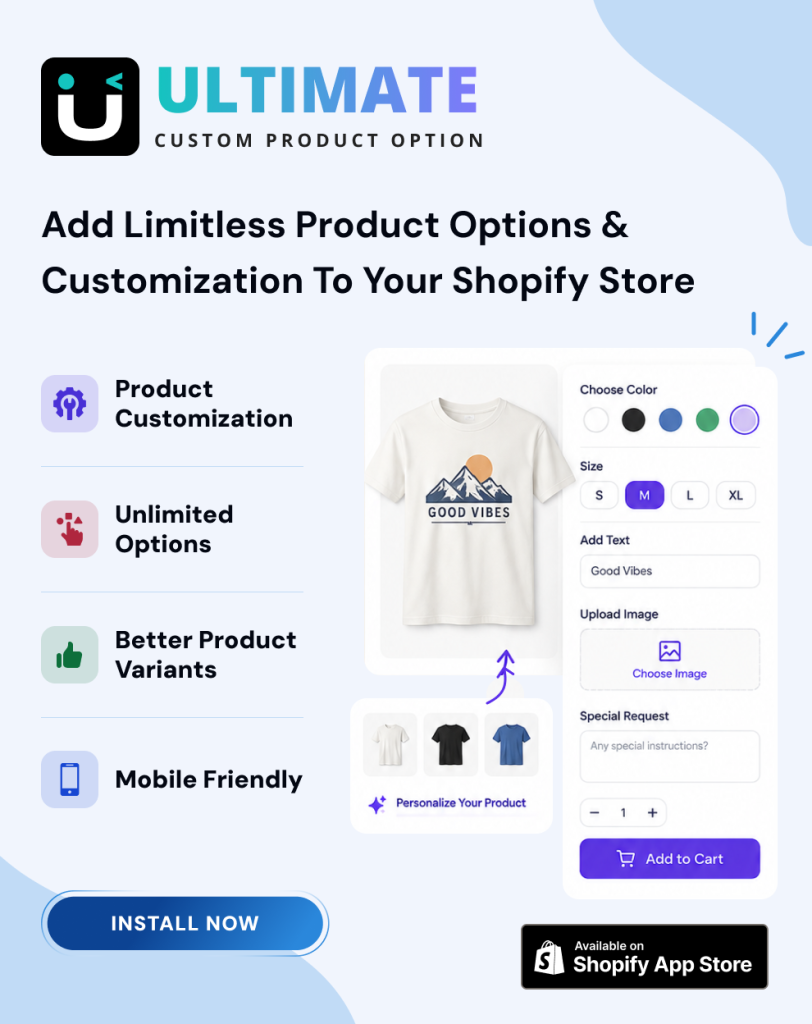
A Tool Built for This: Ultimate Custom Product Options
If you’re on Shopify and you’ve been wrestling with any of the above, Ultimate Custom Product Options is worth a serious look.
It’s built specifically to break through Shopify’s native variant ceiling and give you the flexibility to sell products the way your customers actually want to buy them.
Here’s what stands out:
Unlimited product options. No ceiling on how many option types or configurations you can offer. Sell a fully customizable product with 15 input fields if you need to — the app handles it cleanly.
Every input type you need. Text fields, dropdowns, radio buttons, checkboxes, color swatches, image swatches, file uploads, number inputs, size charts — it’s all there. You’re not patching together multiple tools.
Conditional logic that actually works. Show a “Gift Message” field only when someone selects gift wrapping. Hide irrelevant options based on earlier choices. This alone dramatically improves the product page experience and reduces customer confusion.
Add-on pricing. Want to charge more for premium engraving, rush delivery, or a custom box? You can attach extra charges directly to specific option selections, and Shopify’s cart updates automatically. This is a direct lever on your average order value.
Bulk assignment across products. Create an option set once and apply it to dozens of products at the same time – a huge time-saver for stores with large catalogs.
Analytics built in. See which options your customers are actually choosing, so you can make smarter decisions about what to offer and what to retire.
Free plan available, Pro at $10/month. The free tier is genuinely useful for smaller stores and testing. The Pro plan at $10/month removes all limits — a straightforward investment for any store doing meaningful volume.
The app is built by Webiots Web Creators LLP and is available directly on the Shopify App Store with a 14-day free trial on the Pro plan.
Is a Product Options App Right for Your Store?
Ask yourself a few questions:
- Do you sell any product where customers want to personalize it (names, messages, colors, sizes beyond Shopify’s 3-option limit)?
- Have you ever gotten a customer support request because the product page was confusing?
- Are you leaving money on the table because you can’t offer premium add-ons at checkout?
- Do you manage a large catalog and dread the thought of updating options product by product?
If you answered yes to any of those, you’ve already been living with the variant limit problem – even if you didn’t call it that.
The Bottom Line
Shopify’s native variant system is solid for what it was designed to do. But the moment your products require real personalization – or the moment you exceed 100 combinations – you need a different tool for the job.
A product options app doesn’t replace Shopify’s variant system. It extends it, filling in every gap that Shopify left by design. The result is a cleaner backend, a better shopping experience, and usually a higher average order value.
If you’re ready to stop working around Shopify’s limits and start building the kind of product pages that actually convert, Ultimate Custom Product Options is a great place to start — and the free plan means there’s no reason not to try it.